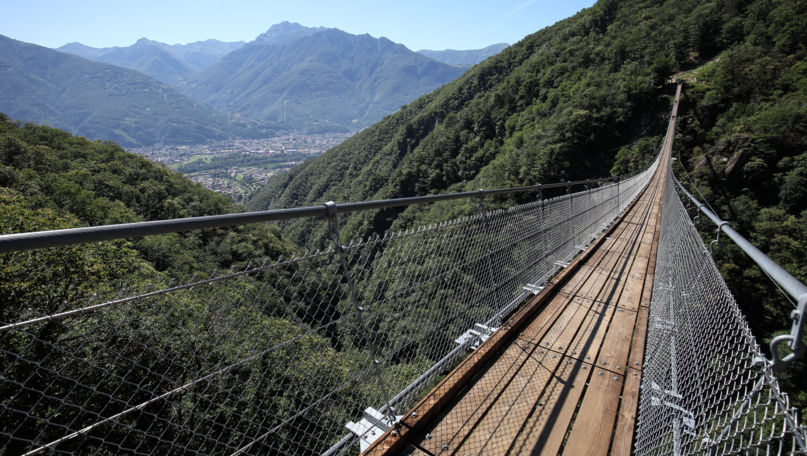
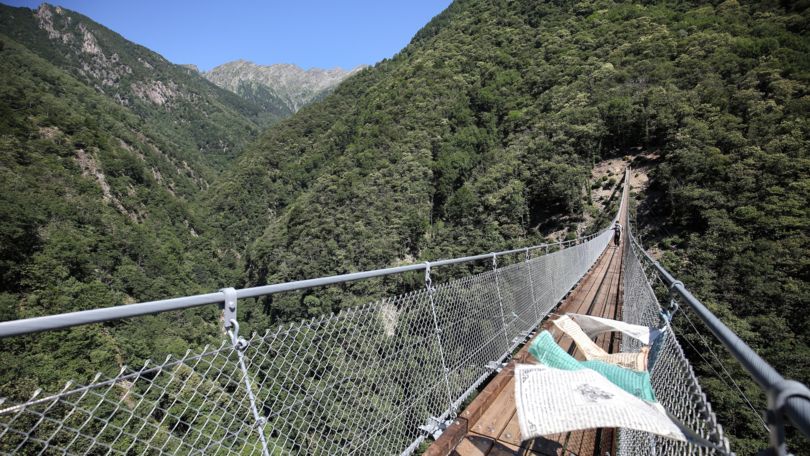
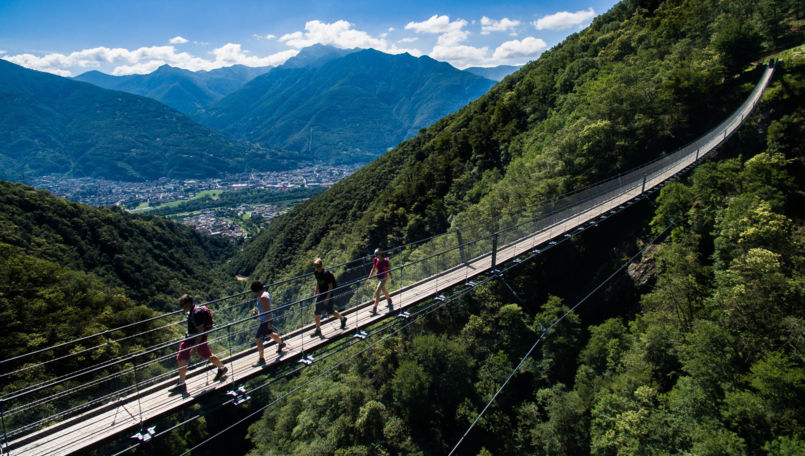
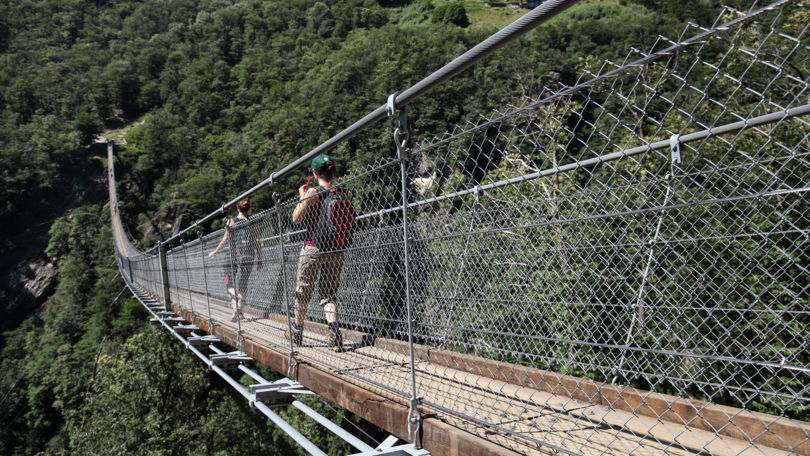
Heart pounding, you step onto a slender ribbon of larch boards suspended 130 metres above a rushing creek, and the world falls away. The Tibetan bridge near Curzutt is one of the longest in Switzerland at 270 metres, and crossing it is just one unforgettable moment on a four-hour hillside walk that blends adrenaline with art, history, and some of Ticino's finest wine. Medieval frescoes, sun-drenched vineyards, and a beautifully restored stone hamlet complete a day that moves between the thrilling and the contemplative.
Itinerary: Curzutt (4h, see map)
The hike begins in Sementina (Via alla Serta). Pass through the gateway of the "Fortini della fame" (Hunger Towers) and follow the path that merges with "Via delle Vigne." At Mondo, leave the vineyard trail and climb toward San Defendente. This opening stretch crosses a striking hilly landscape carpeted with sun-drenched vineyards tended by three small growers, all producing excellent wines.
On the beautiful upland of San Defendente, an old medieval oratory of the same name displays 16th-century frescoes. Beyond here the landscape shifts: vineyards give way to chestnut forests that shade the trail all the way to the bridge. Through gaps in the foliage, the Bellinzona Castles, the San Bernardo Church, and Curzutt emerge into view.
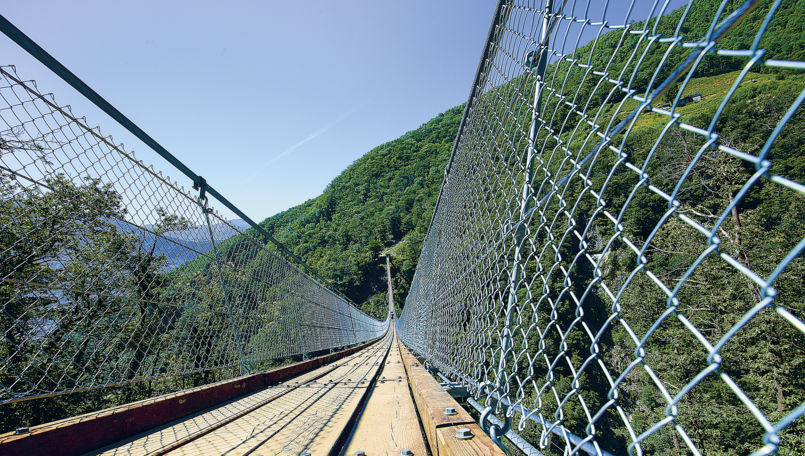
The Tibetan bridge appears near the end of the path, slender and elegant. Its 728 larch boards, safety wire mesh, and handrails make the crossing secure, yet the sheer scale is breathtaking: 270 metres long, suspended 130 metres above the creek. For those with a steady gaze, the midpoint offers a magnificent panorama of the Magadino Plain, the surrounding mountains, and, in the distance, the Castles of Bellinzona. After the bridge, a challenging stretch leads to the church of San Bernardo.
The church of San Bernardo
This small Romanesque church stands in a woodland clearing. Though it appears isolated today, it was once central to village life. Its origins date to the late 11th century. Inside, the architecture is simple, but 14th- and 15th-century frescoes cover virtually every wall. The painting of the Last Supper is particularly fascinating: the artist placed distinctly local products on the table, including freshwater crabs and cherries. Should the church be closed, collect the key at the hostel or restaurant in nearby Curzutt.
Curzutt's old cluster
Just a short distance from the church, the old hamlet of Curzutt sits at 600 metres elevation. In centuries past, people lived on the hillsides rather than the plains, both to escape the flooding and malaria of the Ticino River and to avoid marauding armies vying for control of Bellinzona, a key gateway to the Alps. The Fondazione Curzutt-S. Barnard has beautifully restored the stone buildings, gardens, and terraces that once supported grain fields and vineyards. Far from a static museum, the hamlet pulses with life: a welcoming hostel, a top-level restaurant, renovated stonewalls, a charming children's playground, and the old mule path brought back to its former grace.
From Curzutt, descend through sun-warmed vineyards to Monte Carasso, passing the church of SS. Trinita and the curious cylindrical Fortini della fame (Hunger Towers). Alternatively, a cable car departs from the intermediate station at Curzutt, though waiting times can be long.
Shuttle bus service and Infopoint
From spring through the end of October, a shuttle bus runs between the Infopoint in Monte Carasso and the trail. Morning departures to San Defendente's oratory leave every 45 minutes between 9:15 am and 12:45 pm. Afternoon shuttles return from the Pairolo parking area below Curzutt. The service operates in fair weather only: from April to June on Fridays, Saturdays, Sundays, and public holidays; from July to October daily. Tickets for both the shuttle and the cable car are available at the Infopoint in Monte Carasso.
Info, timetables, prices: Infopoint Monte Carasso, via El Cunvent 3 - tel. +41 (0)58 203 14 50 - [email protected]
For wine lovers
The hillside along the right bank of the Ticino River harbours some of the canton's most compelling wineries. A stroll through their vineyards is a truly enjoyable experience, though tending these steep, hard-to-access plots demands extraordinary dedication, compounded in recent years by recurring wild boar raids. Working these slopes takes nearly twice the labour of valley vineyards, but the constant sunshine and fresh mountain air produce grapes of exceptional quality, yielding several outstanding cultivars.
At Curzutt's restaurant-hostel, you can taste wines produced on-site from grapes grown in a restored historic vineyard planted with hybrid varieties. Down in Monte Carasso, a short walk from the cable car station, three notable producers await: "Cantina Settemaggio" (Marcionetti family), "Cantina Pizzorin" (Giancarlo Pestoni), and "Cantina I Fracc" (managed by Christian Rigozzi). In Sementina, where the excursion begins, visit the cellars "Colli di Sementina" and "Azienda Mondo."
You might also like
Trekking
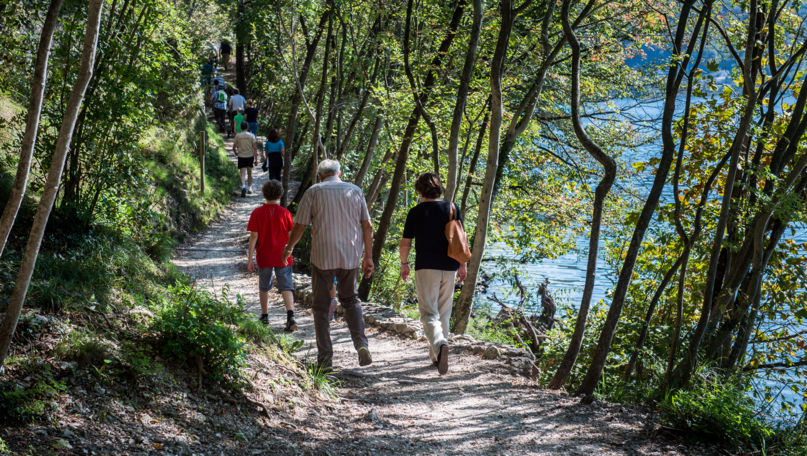
Around Monte Caslano
A pleasant walk on the shores of Lake Lugano allows you to explore the peninsula of Caslano, a typical Ticino village, dominated by a hill of 500 meters.
Trekking
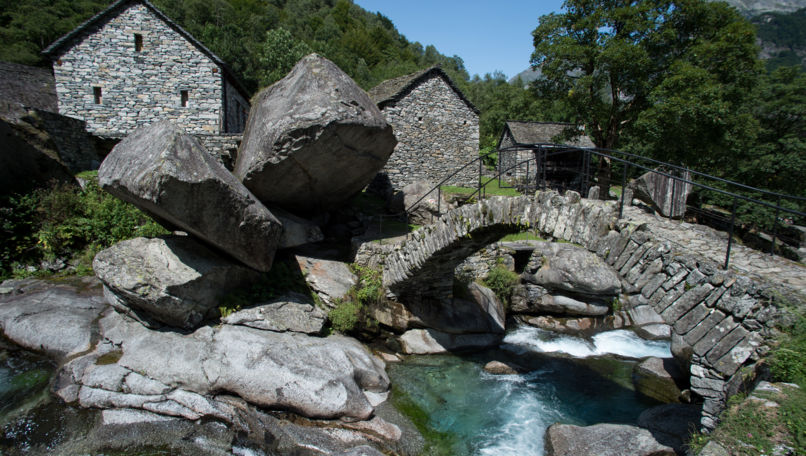
Bavona Valley
Bavona Valley, which branches off from the Maggia Valley, is characterized by its wilderness.
Trekking
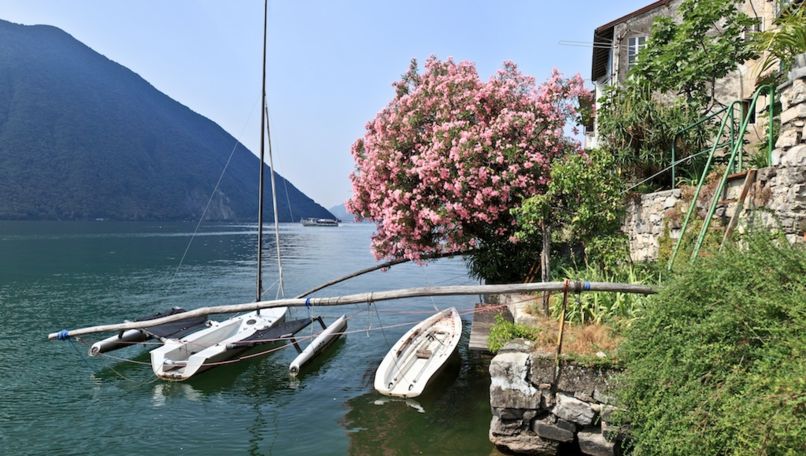
Gandria Trail
The Sentiero di Gandria (Gandria Trail) is a "must" for those vacationing in the Lugano Bay.