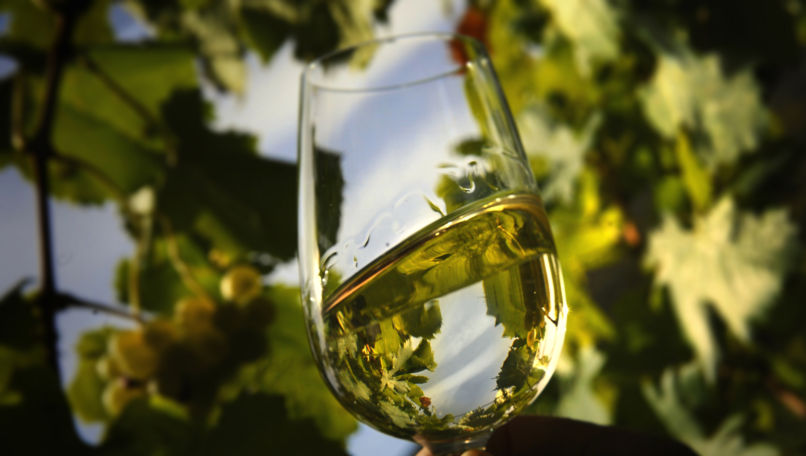
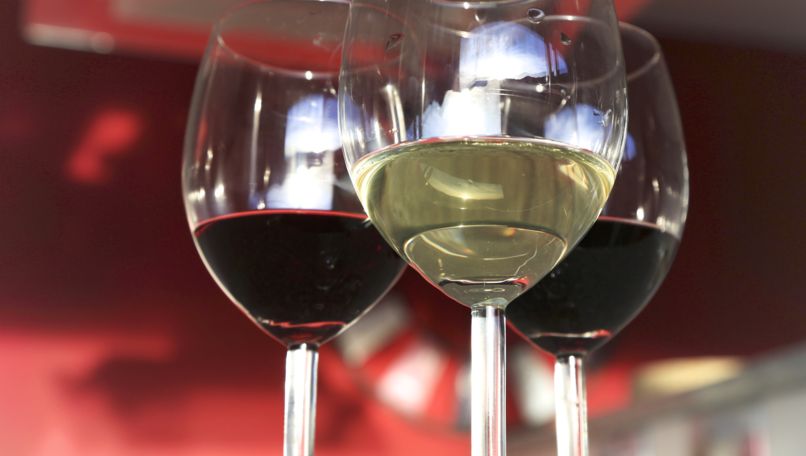
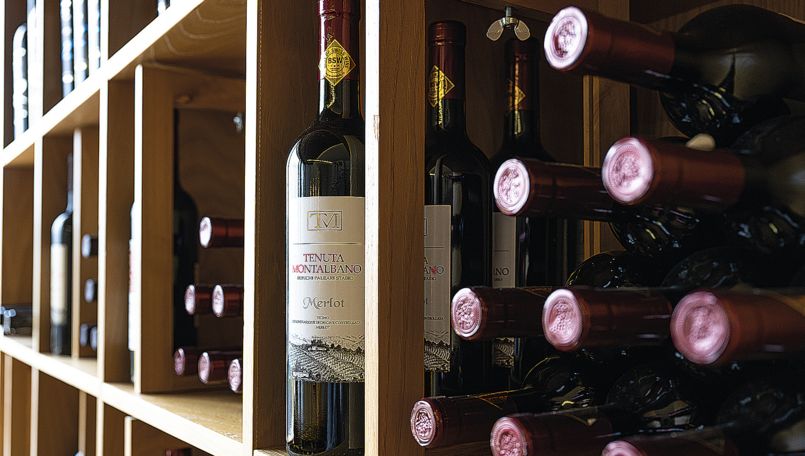
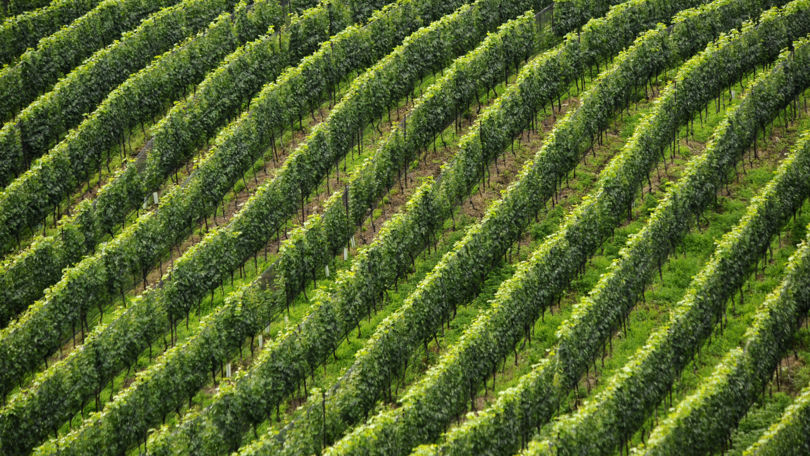
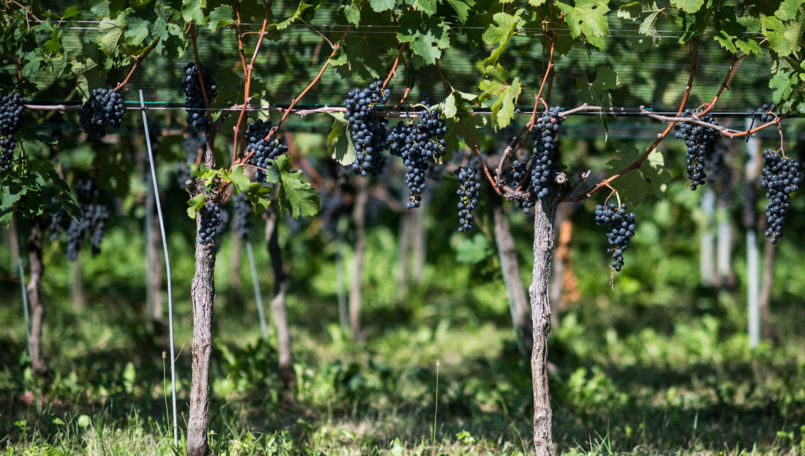
Swirl the glass, inhale deeply, and let the intense ruby-red colour tell you everything you need to know: Ticino's wines have arrived on the world stage. Over the past decades, the region's reds have earned international acclaim, standing shoulder to shoulder with some of the finest bottles on the planet at prestigious competitions. The grape behind this renaissance is Merlot -- the same noble variety that defines Bordeaux -- and it accounts for a remarkable 82% of vineyards in Italian-speaking Switzerland. Today, Ticino Merlot is also vinified as a white with outstanding results. To truly understand the bond between this grape and its adopted homeland, follow an itinerary that traces the very hillsides where the first Merlot vines were planted over a century ago.
The Ticino grape, generally harvested at the end of September, yields a wine of intense, sharp ruby-red colour with a balanced body and pronounced character -- ideal for maturation in small oak barrels. Two distinct types of terrain, corresponding roughly to the south and north of the canton, lend the wines their individual personalities. Depending on terroir and winemaking approach, Ticino Merlots pair beautifully with rich sauces, grilled or roasted red meats, braised dishes, game, and the excellent cheeses produced on the region's mountain pastures.
The history of wine in Ticino
The story of Merlot in Ticino began roughly a century ago. After the devastating grape phylloxera -- a disease originating in America -- ravaged the canton's vineyards, as it did across most of Europe, the government promoted the introduction of Merlot to replace the native varieties that had been destroyed.
Acceptance was slow. A handful of cooperatives and firms began championing Ticino Merlot towards the end of the 1900s; it was the Matasci company from Tenero, in particular, that introduced the wine north of the Alps with its Selezione d'ottobre, still a beloved label today.
The true oenological revolution, however, arrived in the 1980s, driven by a group of Swiss-German intellectuals with academic backgrounds who had adopted Ticino as their homeland, drawn by the climate and the Latin culture. Led by Christian Zundel, Daniel Huber, Werner Stucky and Adrian Kaufmann, this group brought Bordeaux-influenced winemaking traditions to the canton. At the same time, a generation of Ticinese "founding fathers" -- Fabio Arnaboldi, Luigi Zanini, Cesare Valsangiacomo, Claudio Tamborini and Sergio Monti -- pursued the same path, studying at the University of Bordeaux. Today, a growing wave of young winemakers, freshly trained in oenology, are returning to Ticino to cultivate their own vineyards and craft their own wines.
Stimulated by about ten leading cellars producing exceptional bottles, the Swiss-Italian winemaking scene continues to thrive, having staked its future firmly on quality above all else.
Info: TicinoWine, via Ghitello 3, Morbio Inferiore Tel. +41 91 690 13 53 www.ticinowine.ch - [email protected]
Closely tied to the wine tradition, the production of spirits is also a flourishing activity in Ticino. Highly prized are the grappa -- particularly the one distilled from American grape marc -- and brandy, made from the distillation of fermented grape juice. A specialty unique to the region is nocino, a fragrant liqueur obtained by macerating green walnuts in grappa with sugar and spices.
Scattered across the territory, several signposted walks wind through the Ticino vineyards. Here we present a "historic" walk in Malcantone, where Merlot cultivation began, and another in the Mendrisiotto, the region with the greatest density of vineyards.
Itinerary 1: Back to the Origins of Merlot (2h, see map)
This itinerary retraces the pivotal chapters of Merlot's history in Ticino. Named Tracce d'uomo (Human Traces), the trail loops through Castelrotto, a pocket of land steeped in wine culture. It was here, at the beginning of the 1900s, that Giovanni Rossi first experimented with the Merlot variety after phylloxera had decimated the canton's vineyards. Today, the multi-award-winning Tamborini wine cellar has opened a B&B with a restaurant and wine-tasting point on the same slopes. The route also passes through the commune of Beride, where two pioneers of the 1980s Ticino wine renaissance -- Christian Zundel and Adriano Kaufmann -- continue to make wine.
The circular walk begins at the Lusc school, where parking is available. Proceed on foot for a few hundred metres along the road towards Castelrotto, then follow the Tracce d'uomo signs and climb left to the church (12th century). From the fountain in the village centre, take a hairpin bend to the right, then ascend a stairway to the left of the road leading to Villa Orizzonte -- the home of Giovanni Rossi, the man credited with introducing Merlot to Ticino. It was in the vineyards behind this elegant 19th-century villa that the Merlot adventure was born. Today these same vines are tended by Christian Zundel.
Continuing along the narrow lane, you arrive at the Vallombrosa Estate, where the first vineyards were also planted by Giovanni Rossi. The estate is now managed by the Claudio Tamborini wine cellar, which in 2012 was awarded the title of best wine of Switzerland.
Return to the fountain and follow the signs to Ronco. Near a bridge, turn right, following the Tracce d'uomo markers into a forest. You will pass a small cellar and then an old abandoned dairy. Not far beyond, a gravel road climbs to a panoramic viewpoint overlooking vast vineyards owned by Zundel and Adriano Kaufmann. At the intersection, descend towards Ronco to continue the itinerary, or head uphill to the village of Beride for a visit to the Zundel or Kaufmann wine cellars (by reservation only). The Zundel cellar sits behind the church; Kaufmann's is in the opposite direction, about 200-300 metres along the road to Bedigliora.
After visiting the cellars, return to the intersection and follow Tracce d'uomo down towards Ronco. Two detours are signposted along the way. The first leads to the giazzera -- a four-metre-deep pit that was once filled with compacted snow and used to preserve food. The second, near Ronco, brings you to a mist net constructed at the end of the 1700s, once used to catch migratory birds. Through lush chestnut woods, the trail finally loops back to the starting point.
Info: Tourist Office LuganoRegion, Piazza Lago, Caslano Tel. +41 58 220 65 01 www.luganoregion.ch - [email protected]
Itinerary 2: Wine Trails in Mendrisiotto (3h, see map)
The second trail winds through the Mendrisiotto at the extreme south of Ticino. This magnificent region -- with its rolling hills, terraced vineyards and amber-stone villages reminiscent of Tuscany -- is the richest wine-growing area in the canton. A Mediterranean climate and a favourable position conspire to produce grapes of the highest quality.
The circular trail departs from Seseglio, a small settlement at the foot of the Penz hill. In the Moreggi area, the sosta dei fungiatt ("mushroom seekers' stop") pays homage to the hill's abundant mycological treasures, with nearly 500 different species recorded. Strolling amidst vineyards and broadleaf woods, you reach the southernmost point of Switzerland -- an area known as "Laghetto" ("small lake"), despite having no actual lake. A short walk further, a belvedere offers sweeping views over the rooftops and landscape below.
The trail is enriched by the picturesque village of Pedrinate and the small, historic church of Santo Stefano, set apart on a gentle hillock and not usually open for public visits.
An anecdote: along the path you will notice a row of birch trees. Legend has it that at night, their pale trunks served as guiding beacons for smugglers.
Throughout the route, informative panels offer insights on grafting and viticulture, the vegetative cycle of vines and methods of disease protection.
Info: Tourist Office Mendrisiotto, Stazione FFS, Mendrisio Tel. +41 91 641 30 50 www.mendrisiottoturismo.ch - [email protected]
You might also like
Specialties
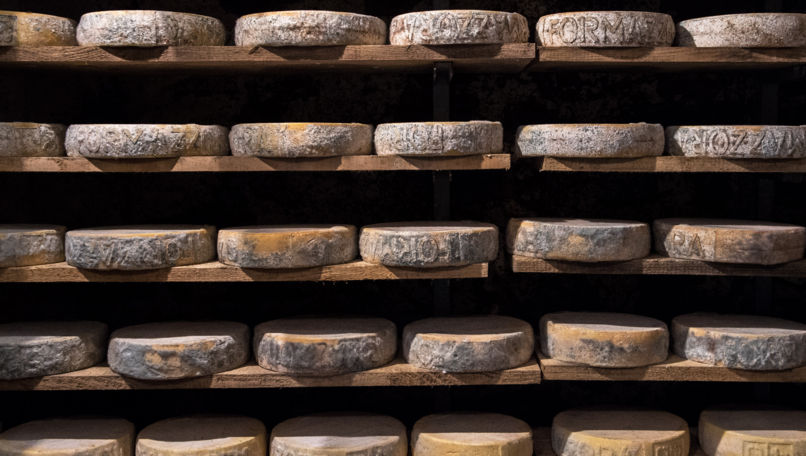
Cheese
From the poor role of polenta-garnish in traditional dishes of yesteryear, Ticino's cheese has become a delicacy served in luxurious restaurants with audacious garnishes like honey, candied fruit condiments, sweet or straw wines.
Specialties
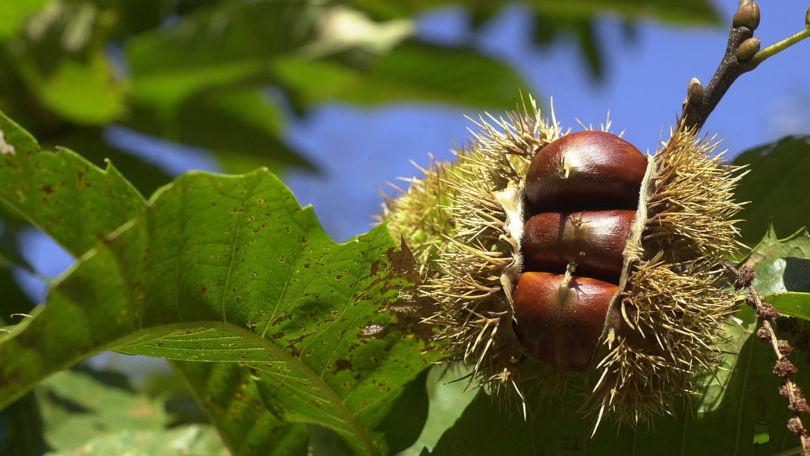
Chestnuts
In Ticino, for centuries, chestnuts were an important staple food for peasants.
Specialties
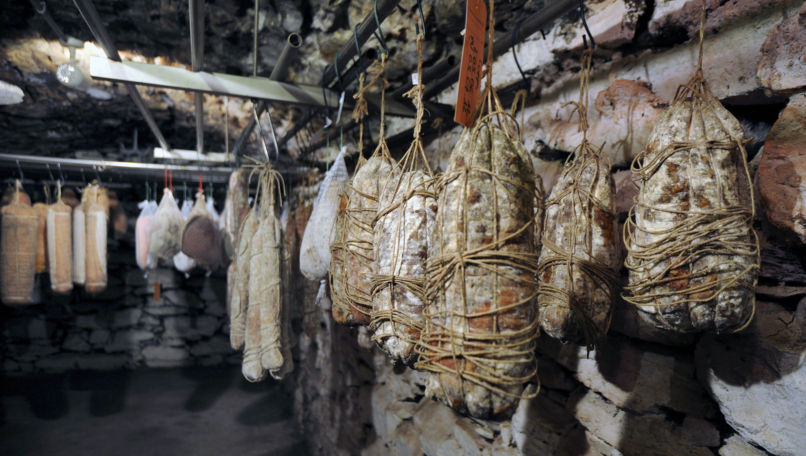
Cured meats
One of Ticino's most deep-rooted traditions is the "mazza" (the processing of pork, but also goat's meat and beef), a tradition that used to bring together families and village communities.