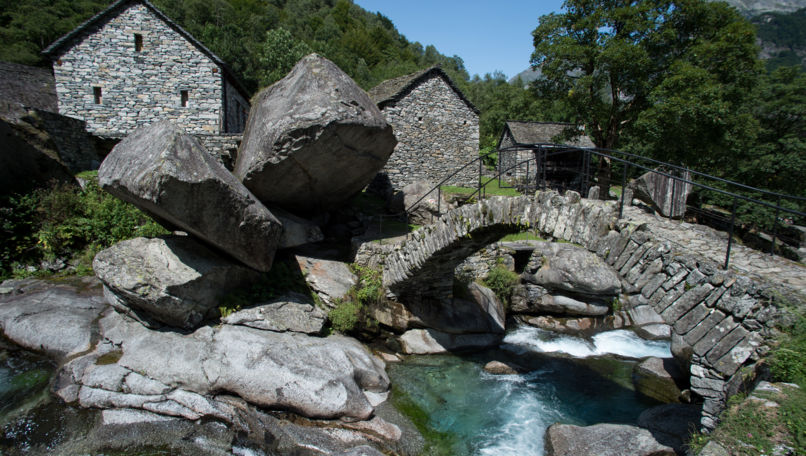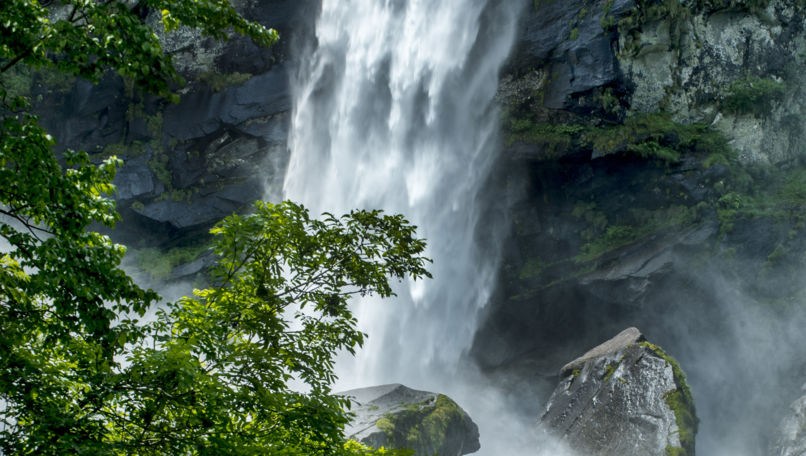
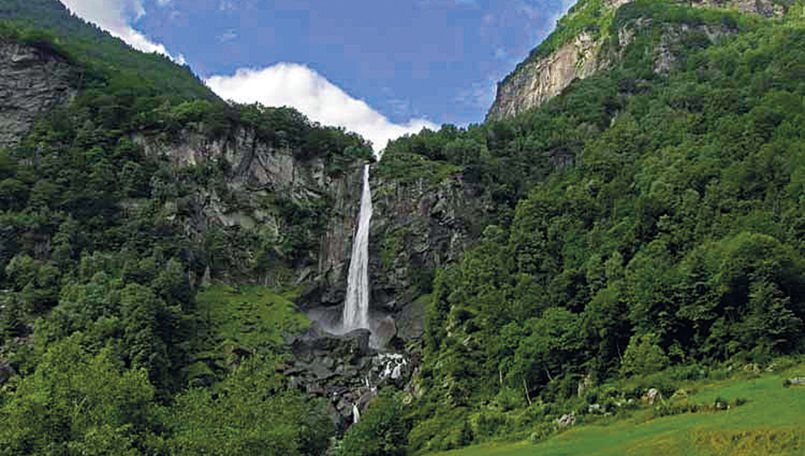
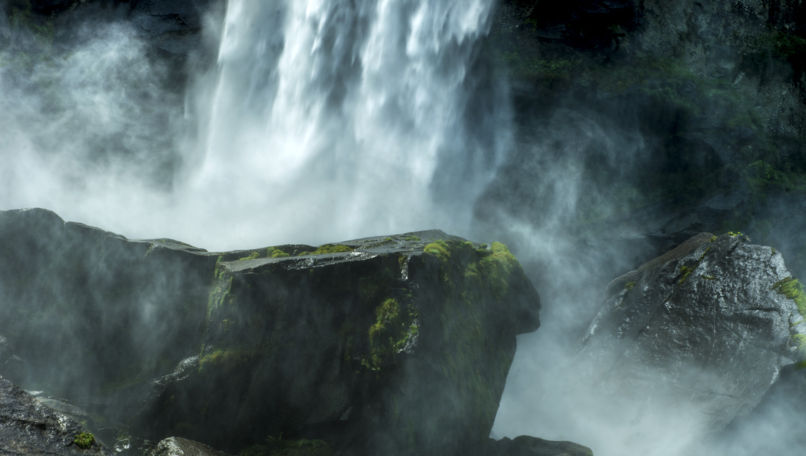
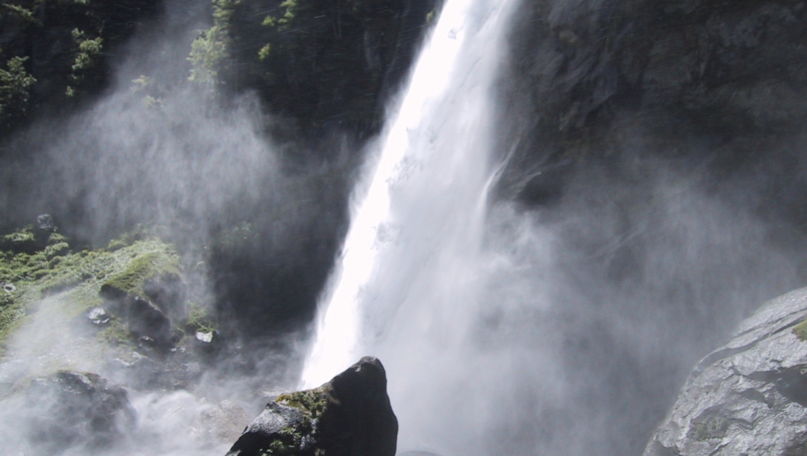
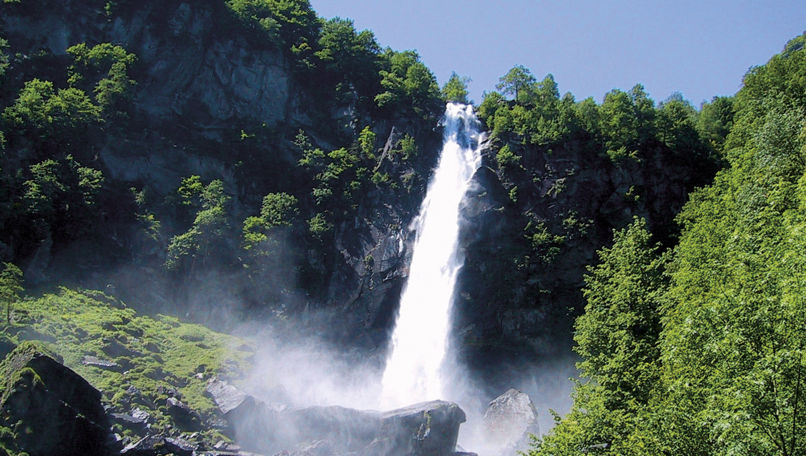
You hear the Foroglio waterfall before you see it -- a thunderous roar echoing off granite walls at the head of the Bavona Valley. Then the view opens up: a white torrent plunging 110 metres through clouds of mist and spray, framed by the raw, wild beauty of one of Ticino's most dramatic landscapes. At its foot, a cluster of stone houses gathered around a little church stands as a silent testament to generations of mountain people who practised transhumance, inhabiting the Bavona Valley only from spring to autumn. It is the most spectacular waterfall in Ticino, and an itinerary through the surrounding rock-sculpted landscape reveals just how extraordinary this corner of the Alps truly is.
As Professor Bruno Donati explains in his guide Foroglio: "A waterfall forms only when there is a highly accentuated gradient -- which, in the case of Foroglio, was created by the joining of two glaciers. The first, gigantic and mighty, carved the main Bavona Valley; the second, smaller and less powerful, collected perennial snows from the Calneggia Valley. When the ice melted between 8,000 and 10,000 years ago, two depressions emerged: a main valley and a suspended lateral one, connected by the waterfall's watercourse."
Beside the cascade, the gracious village clusters around its 15th-century church, which houses a Germanic school triptych of 1553 and a Roman-style painting from the late 16th century depicting the "Presentation of the Virgin at the Temple." Among the traditional stone houses stand several torbe -- buildings that once served as barns, with stone bases supporting mushroom-shaped pillars topped by wooden upper storeys. These date from the era of rye cultivation, when sheaves were set to dry on the landing and stored in the barn cell above.
The valley produced one of Ticino's most beloved writers, Plinio Martini, whose Fondo del sacco (Bottom of the Bag) vividly chronicles the peasant life of these mountains.
The Osteria Froda, perched in Foroglio with a splendid view of the waterfall, is run by Martino Giovanettina, himself an author and intellectual. As Marco Muller, former director of the Locarno and Venice Film Festivals, once described it: "Here one can truly breathe another life, gaze at the waterfall and eat a minestrone or polenta with cheese based on some recipe long lost in the city."
If you have more time... Itinerary: Foroglio - Calnegia Valley (2h, see map)
This moderately challenging itinerary unfolds along cliff faces, stony ground, boulders, and minuscule stone huts surrounded by sparse alpine meadows -- a landscape profoundly shaped by glaciers, rivers, floods, and landslides. During the warmer months, the peasants of Bignasco and Cavergno would move to the Bavona Valley, exploiting every tuft of grass, and ascend into the Calnegia Valley above Foroglio. Evidence of their resourcefulness is everywhere and deeply moving: every cleft, every boulder was pressed into service as shelter for people, livestock, cheese, hay, or firewood. Human labour and the mineral-and-vegetable world have merged here in an admirable harmony of adaptation and domestication.
Leaving Foroglio in the shadow of the magnificent waterfall, a steep trail climbs to the plain above. Here you encounter Puntid, a mid-altitude pasture from which a detour of roughly 20 minutes (round trip) leads to the Spluia Bela, an impressive building sheltered beneath an overhanging rock that once housed herdsmen and their goats.
Returning to Puntid, cross a charming little bridge and continue along the flat valley floor for about 3 kilometres between soaring stone walls. A signposted detour leads to Gerra, another beautiful mid-altitude pasture. Back on the main trail, you soon reach Calnegia, the last settlement before a very steep ascent to the high mountain pastures -- reserved for experienced and well-equipped hikers. The return to Foroglio follows the same route.
Caution: bathing in the pools near the waterfall can be dangerous. Note: mobile phone reception is unavailable in the Calnegia Valley.