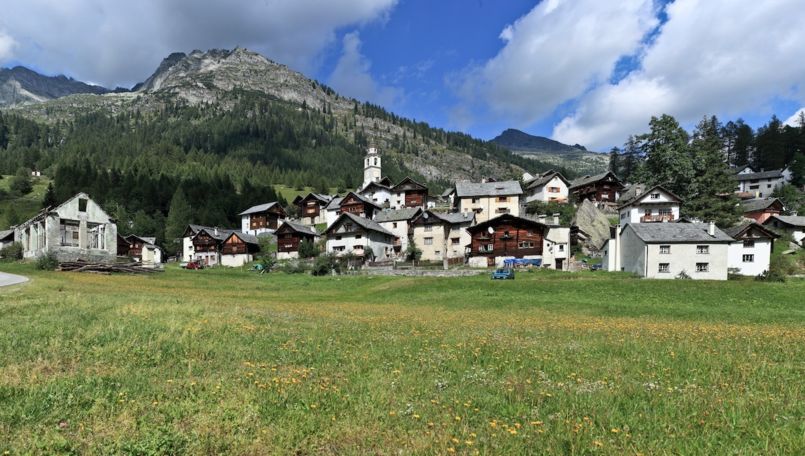
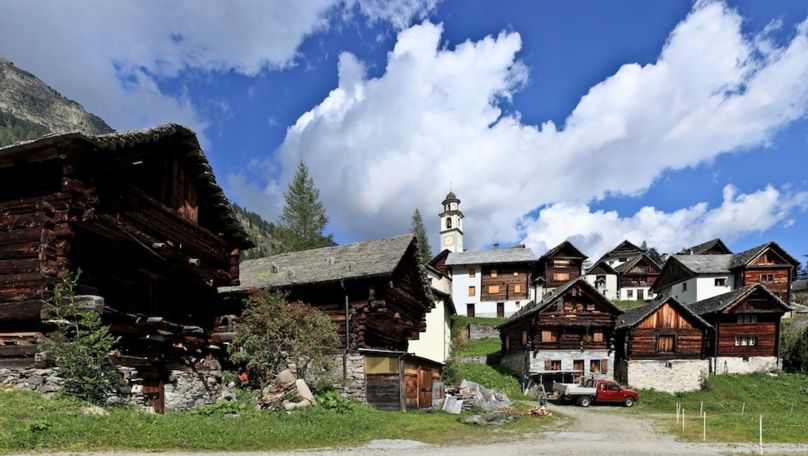
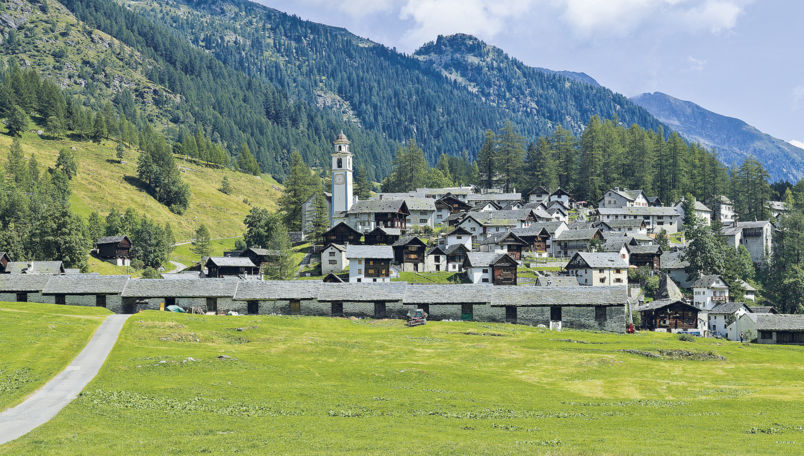
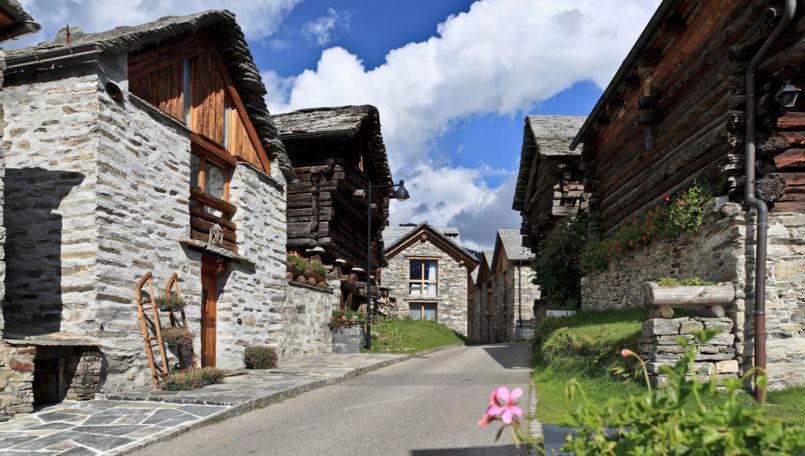
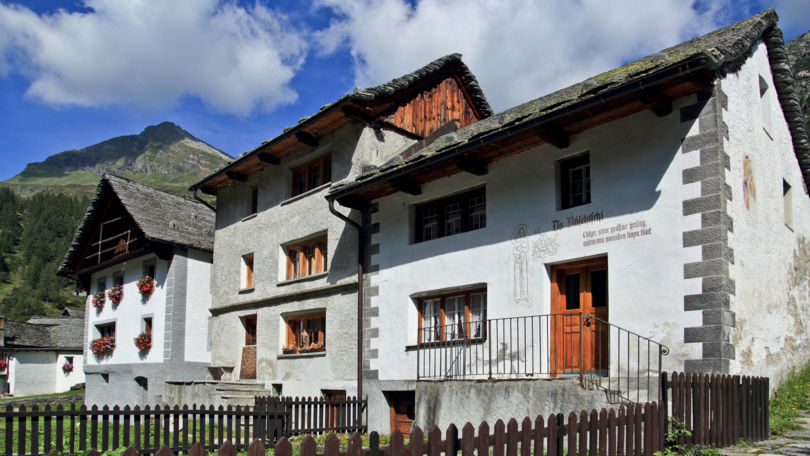
At 1,500 metres in the Maggia Valley, Bosco Gurin is Ticino's highest village and its most culturally surprising. Here, amid the dark timber of Walser houses and the weathered stone of Alpine barns, you can still hear echoes of a German dialect -- a living testament to the small Walser community whose ancestors crossed the mountains from the German-speaking Valais Canton in the 13th century to settle these high lands. Beyond the language, the architecture itself tells their story: wooden houses and distinctive torbe granaries recall Walser building traditions, while a small museum preserves the material memory of a civilisation superbly adapted to life at altitude. The village facades, decorated with striking graffiti, add yet another layer of visual richness.
The visit
The traces of the Walser settlers who arrived in the 13th century after crossing the Guriner-Furka Pass reveal themselves throughout the village's narrow streets. To make the most of your visit, pick up a "Bosco Gurin e i Walser" booklet (available in Italian or German) at the tourist office in Avegno, where the entire collection of Sentieri di Pietra (Stone Paths) guides is offered free of charge.
One of Bosco Gurin's most distinctive features is the torba, of which only about fifteen survive. As the booklet describes: "The torba is a wooden construction built on a plinth of masonry which usually housed the stable or storage. The wooden bit is isolated by a given number of stone 'mushrooms', composed of a stem (wood or masonry), frequently topped by a roughly rounded granite plate to hinder mice from reaching the wheat stall. The stall was the safest place to preserve different products such as rye and barley, protecting them from humidity and, as mentioned earlier, from rodents."
Another hallmark of Walser heritage are the Gadumdschi -- buildings with dry-laid stone walls and stone-tiled roofs, lacking a door, once used as barns. Many examples stand at the outskirts of the village. The most ancient stables, combining a wooden upper section with a stone base, cluster behind the church dedicated to the Holy Saints Giacomo e Cristoforo, sanctified in 1252 and restored multiple times over the centuries.
As you wander the alleyways, you will notice numerous buildings decorated with graffiti, the work of Hans Anton Tomamichel. Born in Bosco Gurin in 1899, Tomamichel moved to Zurich at the age of 15, where he later became a celebrated graphic designer -- yet his artistic mark on his birthplace endures.
Before leaving, step inside the Walserhaus Museum, where objects and testimonials offer a vivid window into the living conditions of the past. The old house is the only one in the village still fitted with the "Seelenbalge": a small window that, following an ancient Walser custom, was opened only when a patient died, allowing the soul to pass into eternity.