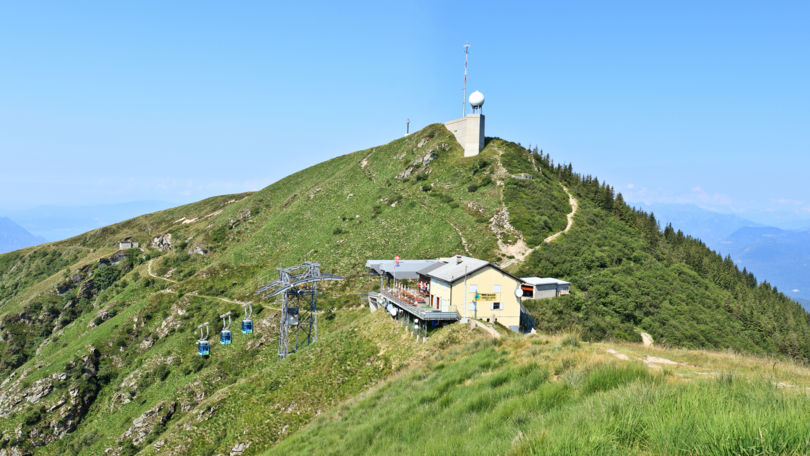
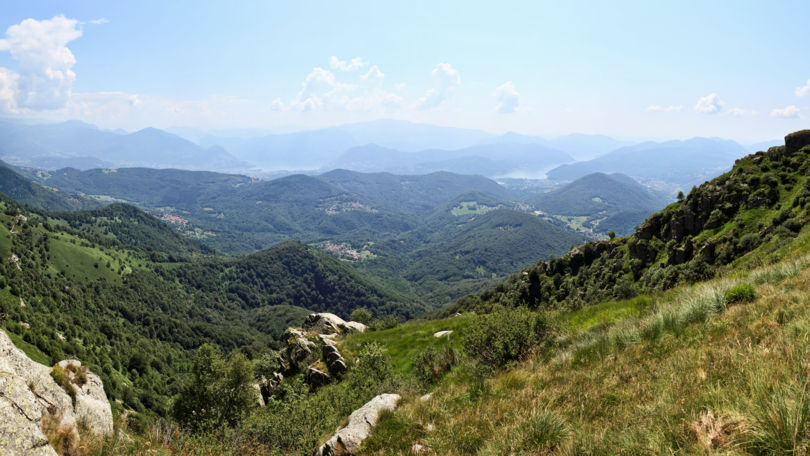
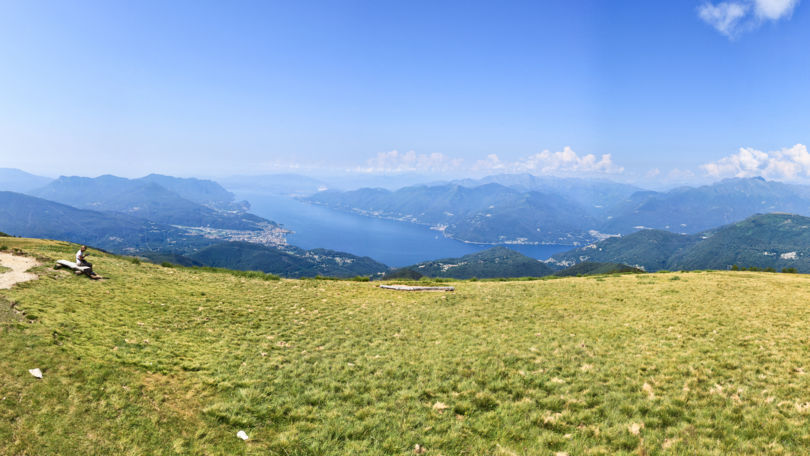
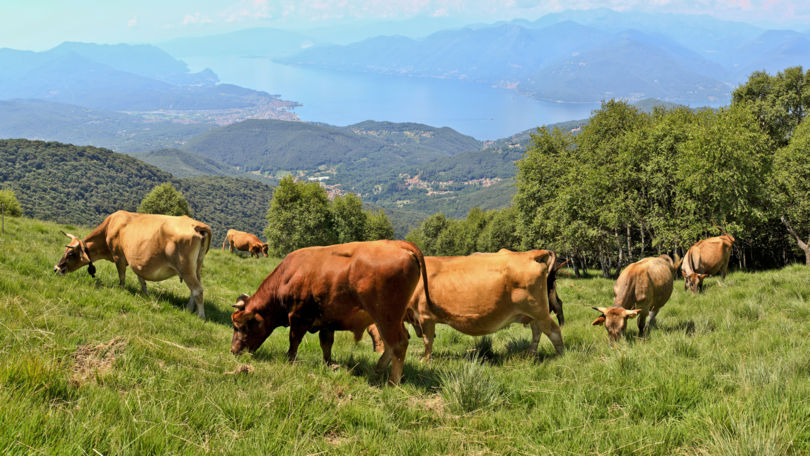
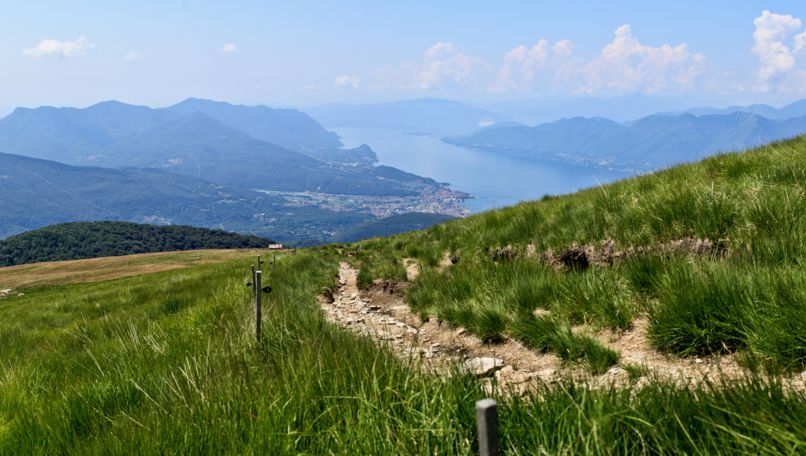
Perched at 1624 m, Monte Lema's broad, grassy summit terrace feels like a natural balcony suspended between earth and sky. To the south, the valleys of Ticino cascade toward the glimmering waters of Lake Lugano and Lake Maggiore. To the north, the panorama deepens into the Graubunden and Bernese Alps, the snow-capped Valais peaks, and on the clearest days, the hazy outline of Milan across the Padan Plain. A cable car from Miglieglia brings you swiftly to the top, which also serves as a departure or arrival point for the legendary high-altitude Tamaro-Lema ridge crossing. At the summit you will find an astronomical observatory, a small playground, and a welcoming restaurant where you can take in the views at leisure.
If you have more time...Itinerary: Between Earth and Sky (3h, see map)
The theme trail Tra Cielo e Terra (Between Earth and Sky) reveals the rich natural and cultural heritage hidden on the slopes of Monte Lema. This corner of the Malcantone, stretching from the communes of Miglieglia and Novaggio to the summit, was once carefully managed common land where residents grazed livestock, gathered chestnuts, and collected firewood according to strict seasonal rules. Today it is an ecological treasure, distinguished by forests of chestnut, beech, oak, and holly.
The walk takes about 3 hours. From Miglieglia, ride the cable car to Monte Lema's summit. The foot trail descends from the peak to the pasture of Piano Pulpito, continues to Forcola, and then proceeds to Cima Pianca.
The first section down to Forcola is the most breathtaking. You walk a high ridge between two shining lakes: Lago Maggiore on your right and Lago Ceresio on your left. On one side the view reaches as far as Cannero, where the ruins of medieval castles rise ghostlike from the water, and across to Luino. On the other, it stretches to the Lugano Gulf and Ponte Tresa. Throughout, the green Malcantone villages lie nestled among the hills below, their terracotta roofs glowing warmly in the sun.
A short detour from the main track, shaded by century-old beech trees, leads to a stone building known as the "turbin" -- an 1853 construction once used to preserve milk products from the pasture. A small stream running through its interior kept the temperature cool and constant, a clever piece of alpine ingenuity.
Continuing down toward Miglieglia, you arrive at a delightful playground fitted with wooden musical instruments, waiting for visitors to coax melodies from the mountain air. In the Caroli area, an educational arboretum gathers over sixty species of trees and shrubs found in Ticino's forests. Along the trail you will also discover the small museo del boscaiolo (Lumberjack Museum), where historic tools and personal accounts bring the hard-won life of the mountain woodcutter vividly to life.
For those who enjoy weaving art into a day of walking, two stops are essential: the church of S. Stefano al Colle in Miglieglia (beside the cemetery), which preserves spectacular medieval frescoes, and the centre of Novaggio, a village transformed into an authentic open-air gallery adorned with murals by contemporary artists.