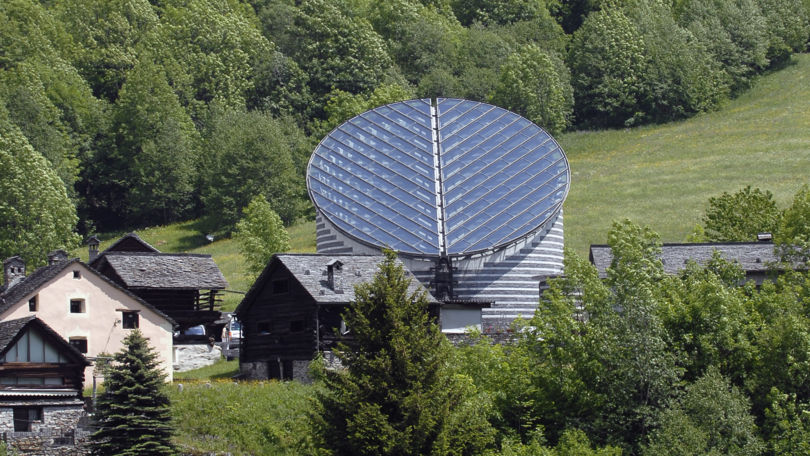
At the head of the Maggia Valley, where mountain walls rise steep and snow lingers late into spring, a small church gleams like a jewel of defiance against nature's raw power. At 7:15 am on April 25th, 1986, an avalanche swept through the village of Mogno and destroyed the 17th-century church of San Giovanni Battista (Saint John the Baptist). From the devastation, a commission was formed and the project for reconstruction entrusted to architect Mario Botta. Controversy surrounded both the design and its realisation, yet what Botta ultimately created in Mogno is considered one of his most significant works -- a building that affirms, in his own words, "the positivity of construction as an expression of the toils of humankind" in the face of nature's devastating force.
The visit
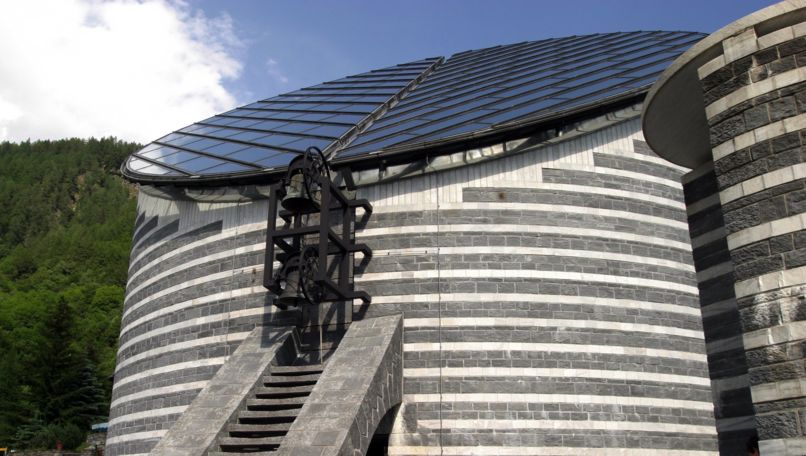
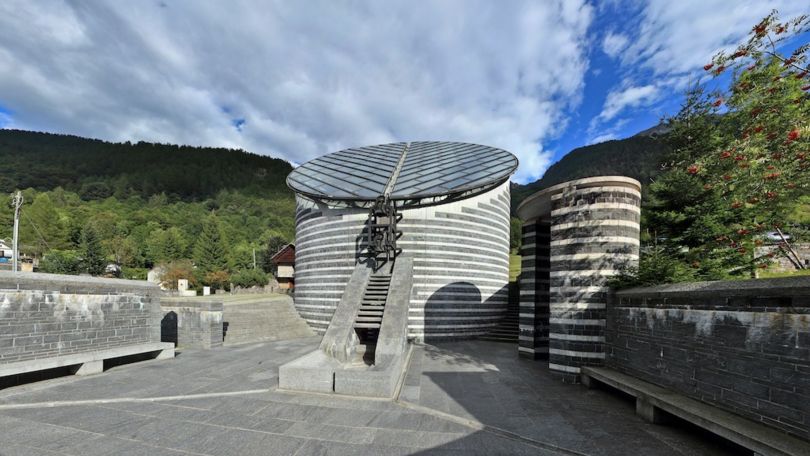
Construction began in 1992 and lasted four years. The new church occupies the exact footprint and orientation of the former one, its height of 17 metres matching that of the old bell tower. The churchyard replaces the cemetery; the ossuary was rebuilt in its original position. The two church bells, cast in 1746, are the only elements salvaged from the building swept away by the avalanche.
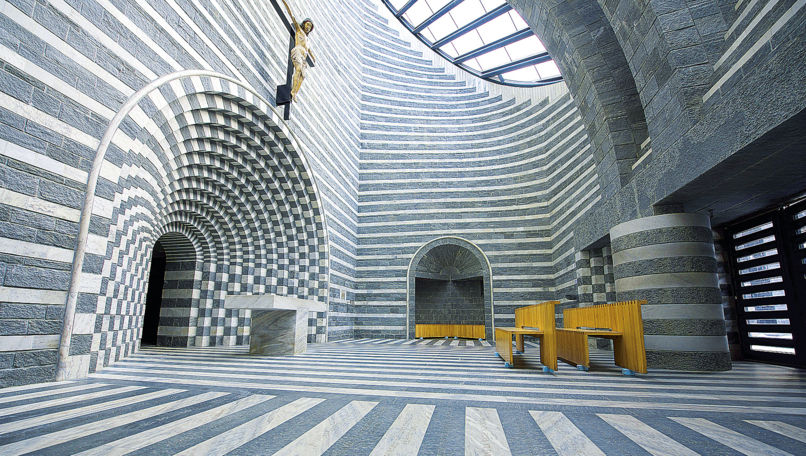
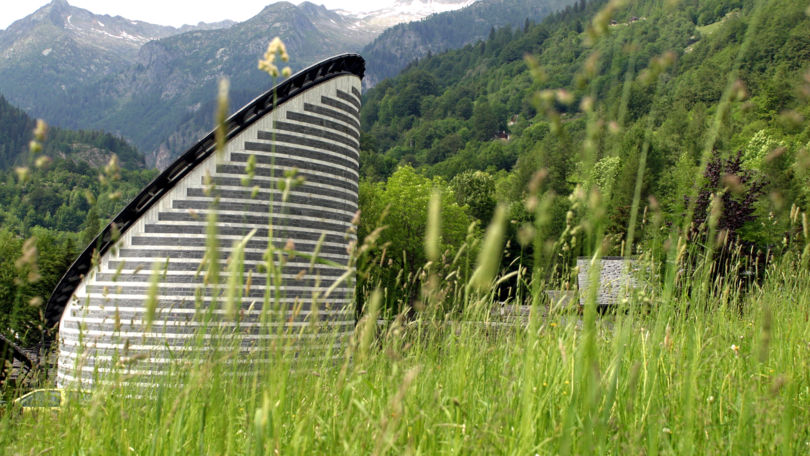
The memory of destruction is woven into the architecture itself. "The image of the ruins, related to the mass of snow that destroyed the old monument as well as part of the village, surfaces once again in the decided inclined 'cut' of the outer walls," explains Botta, "which compress the internal space and force it to expand towards the sky by way of the roof-cum-skylight. The subtle dualism between the levity of the roofing and the strength and thickness of the building, completely new compared to the consistency of a traditional stone roof, testify to the desire for survival on the part of the construction."
The plan describes a basic rectangle inscribed within an ellipse, which transforms into a circle at the roofing level. "The exiguity of the size," the architect continues, "is made up for by the geometrical synthesis between the figures of the rectangle, the ellipsis and the circle, with an entire series expressing the ascent of the human dimension, represented in the regular space of the base, to the divine perfection suggested in the circular roofing."
The walls are 2 metres thick at the base, progressively tapering to 50 centimetres at the summit. "The construction technique," Botta explains, "is based on tradition, highlighting the use of stone not as a covering but as a structural element, seen in the rediscovery of dry-laid stone building by way of blocks with cavities filled with cement." The stones are native to the Maggia Valley: the gneiss (a rock similar to granite, also called beola) was extracted from the Riveo quarry, while the marble comes from the Cristallina quarry in the side valley of Peccia.
Admirers of modern architecture can also visit another striking church by Botta at the Alpe Foppa on Monte Tamaro.
If you have more time... Itinerary: the typical village of Brontallo
On the return journey from Mogno, a small detour to the village of Brontallo is well worth the effort. You can explore it by following the indications in the flyer Sentieri di Pietra (Stone Paths), available in Italian and German at the tourist office in Avegno.
Brontallo, perched at 716 metres above sea level, unfolds as a succession of fascinating discoveries: a cluster of identical stables all facing the valley floor, gathered on the same slope; steep, seemingly endless terraced hillsides; looming rocks sheer above the village; a core of old stone houses with roofs of piode (slates) ascending the gradient; a modest meadow where a handful of newer homes have appeared in recent decades; and, far below, the valley plunging into the gorge of the River Maggia, three hundred metres down.
These very features that captivate today's visitors are the same that made life in Brontallo demanding for generations. For centuries, men, women, and children laboured here with conical wicker baskets on their shoulders, in constant movement -- up and down between village and mountain pastures, from the valley floor (where a road existed as early as 1820 but remained unconnected to the village until 1955) to the slopes on either side where further pastures awaited.
It is no surprise that Brontallo was among the Vallemaggia communes to sell the highest number of houses and stables, particularly to Swiss-German buyers, beginning in the 1960s when a great wave of agricultural abandonment swept through the mountain communities. The old dwellings were transformed into secondary residences -- and in this way, the village was given a second life.