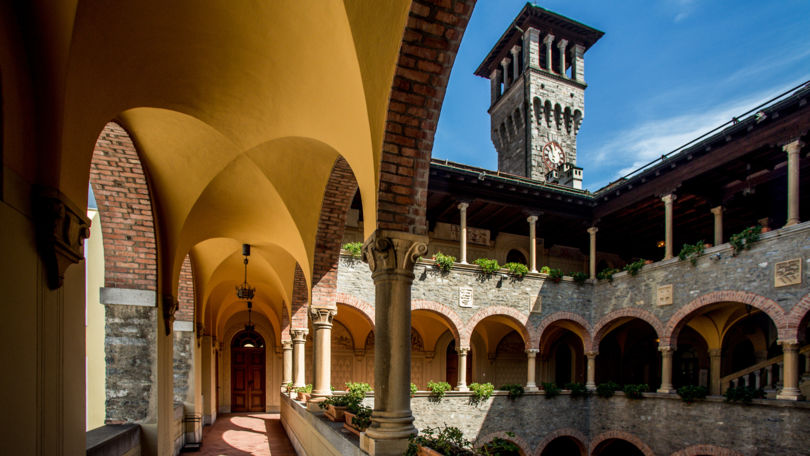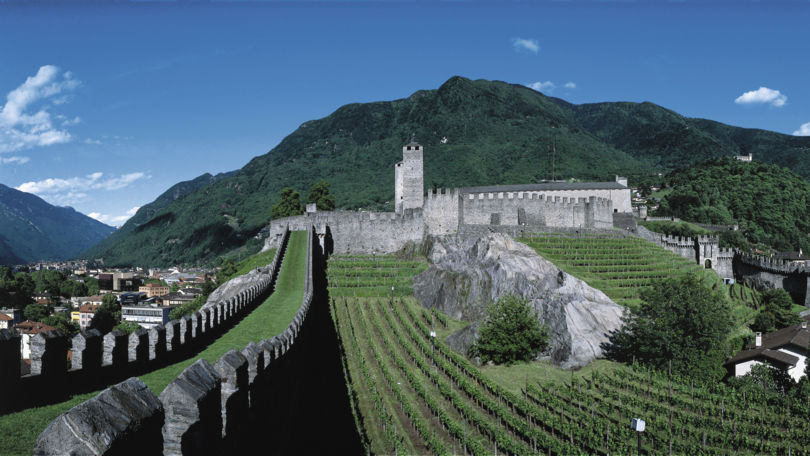
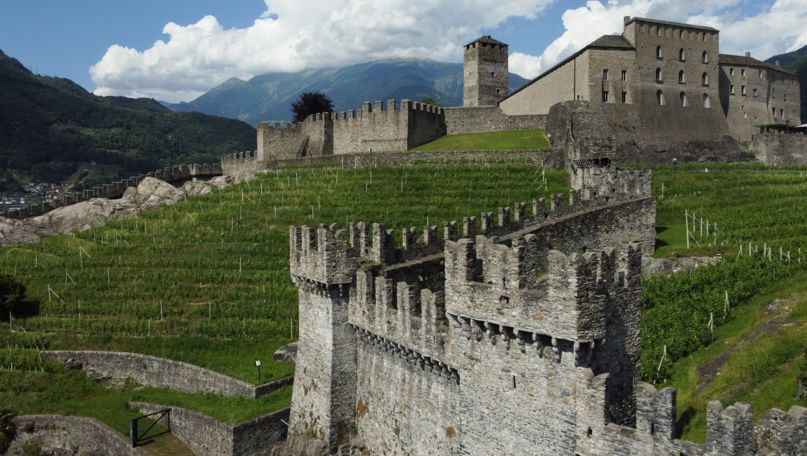
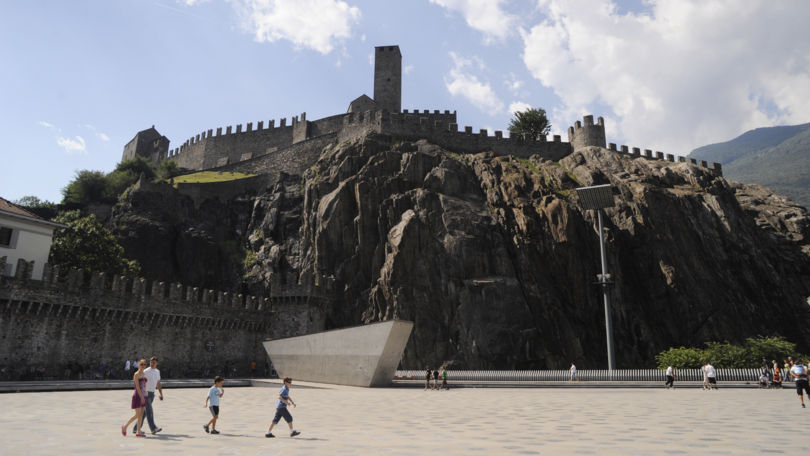
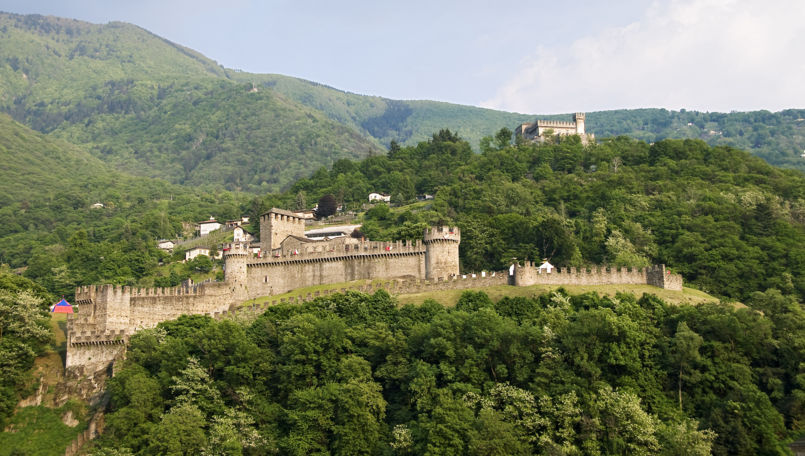
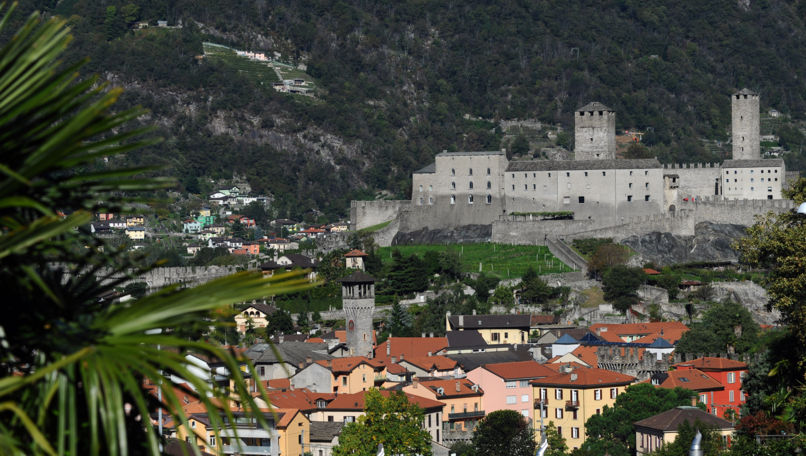
Three castles, their crenellated towers rising above the rooftops, their ancient walls spilling down the hillsides like a stone cascade -- Bellinzona's fortress is a spectacle that stops you in your tracks. Together with the ramparts that still stand between them, these castles form the only intact medieval military complex in the entire Alpine region and have been a UNESCO World Heritage Site since 2000. Walking among the battlements, climbing the towers, and tracing the walls from one hilltop to the next is like stepping bodily into the Middle Ages. The castles are also connected by a tourist train, and audio guides are available. A visit pairs wonderfully with a stroll through Bellinzona's historic centre, especially on Saturday morning when the lively weekly market fills the streets.
Bellinzona's strategic position at the crossroads of the great Alpine routes linking north and south -- the Gotthard, Lukmanier, San Bernardino, and Nufenen passes -- is the reason a formidable defensive system of three castles, towers, and city walls was built here around the year 400. It was the Dukes of Milan who sealed the valley of the River Ticino at its narrowest point, the sole access northward, to block the Swiss Confederates from advancing south.
The visit
Castelgrande
The first and grandest castle, Castelgrande, can be reached by elevator from Piazza del Sole or on foot via the alleys that climb from the historic centre near the Collegiata. A tourist train also departs from Piazza Collegiata. Meticulously restored in the 1980s and 90s under the direction of architect Aurelio Galfetti, Castelgrande is crowned by two lofty towers and crenellated walls that are partially accessible on foot. It houses a museum tracing the history of the city along with temporary exhibitions, as well as a fine restaurant run by the Canton Ticino Tourism School.
The rock on which Castelgrande stands is steeped in history. Archaeological excavations in 1984-85 confirmed habitation dating as far back as the Neolithic period (5500-5000 B.C.) and through Roman times. Earlier excavations in 1967 revealed evidence of the first fortification from the 4th century A.D., and documents from the 6th century also mention this original defensive structure. The castle as it appears today was built in stages: construction began in the 13th century, the complex was enlarged between 1473 and 1486, and further restorations followed in the 17th and 19th centuries. The White Tower and Black Tower date from the 13th and 14th centuries, rising 27 and 28 metres respectively.
Architect Aurelio Galfetti carried out the most recent extensive restorations between 1984 and 1991. The inner courtyard, entrances, elevator, and steps leading down to the town centre stand as a stunning testament to the castle's transformation.
The battlements divide into three sections, one of which still descends directly into the town centre. In the era of the Visconti, this wall reached all the way to the River Ticino. It was built in the late 14th century and fortified by the Sforza dukes of Milan between 1486 and 1489; parts were destroyed by a devastating flood in 1515.
The elegance of the 27-metre White Tower (1250-1350) and the imposing mass of the 28-metre Black Tower (1310) are highlights of any visit. Inside the Black Tower, an entertaining Escape Room dedicated to the Rabadan Carnival -- Bellinzona's legendary celebration and one of Switzerland's largest carnival events -- adds a playful twist.
Montebello
From Castelgrande, descend the stairway to Piazza Collegiata and climb the alley beside the church to reach the castle of Montebello, perched on the opposite hill 90 metres above Castelgrande. This castle also houses a history and archaeology museum.
The defensive walls of the old town originate at Montebello and connect with those from San Michele hill; stretches of both branches still survive, protecting the fortress's north and south flanks. The internal nucleus dates to the 13th/14th century and has undergone several restorations. It was most likely built by the Rusca family of Como, who held it for a long period, even under Visconti rule. The outer courtyards, towers, and the Rivellino were added by Sforza engineers in the second half of the 15th century. During Swiss occupation, the castle was known as Castello di Svitto; when Ticino became an independent canton, it was renamed Castello di San Martino. Toward the end of the 18th century, the Ghiringhelli family acquired it and ceded it to the Canton in 1903 to mark the first centenary of independence.
Inside, an engaging archaeological itinerary (Archeologia Montebello) invites you to retrace the history of the medieval manor, accompanied by a guide in four languages available for download on your smartphone.
Sasso Corbaro
The third castle, Sasso Corbaro, commands the city from its highest vantage point, offering a spectacular panorama that stretches across the valley. It can be reached from Montebello along trails that wind through the vineyards, or by car. Exhibition halls and an excellent restaurant await within.
The Sforzas built Sasso Corbaro in 1479, following the humbling defeat of Milanese troops at the Battle of Giornico. Named after the hill on which it stands, the castle was designed by the Florentine military engineer Benedetto Ferrini and completed in the astonishingly brief span of six months -- tragically, Ferrini died of the plague shortly before its completion. Its dominant position, 230 metres above the town, provided enhanced protection of the Ticino Valley. The castle is starkly geometrical: a square courtyard enclosed by high walls that reach up to 7 metres thick where they join the keep on the northern side.
The lookout tower on the southern side remains nearly intact. Under early Swiss occupation, it was called the Castle of Unterwalden; in 1818 it was renamed Castle of Santa Barbara. Today it goes by Sasso Corbaro, or Castello di Cima. Abandoned in 1798, it fell into disrepair until the Canton intervened in 1870, handing it first to an organisation that planned a hotel conversion, then to three Bellinzona families who used it as a summer residence. In 1919, the state reclaimed the castle and undertook a full restoration, including the rebuilding of the Rivellino (outer courtyard), entrance gates, 17th-century chapel, and well.