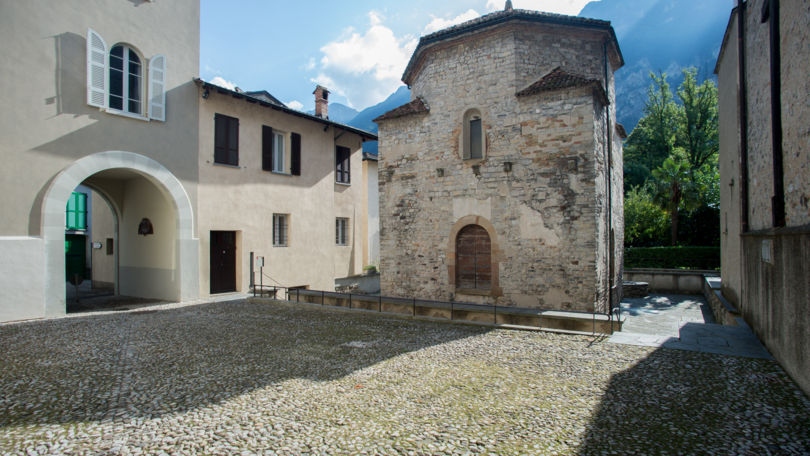
Step inside Switzerland's oldest Christian stone monument and feel fifteen centuries of sacred history settle around you. The Riva San Vitale Baptistery, dating back to the 5th century, rises on an elegant octagonal base above what were likely the foundations of a Roman-era building. Within its thick walls, a rare octagonal immersion baptismal font awaits, while precious 12th-century Romanesque frescoes adorn the recesses and columns with faded yet luminous colour. The village of Riva San Vitale lies just 5 km from Mendrisio, whose own historic centre richly deserves a visit.
The visit
A cornerstone of Christianity's story in Switzerland, the baptistery rewards even the briefest detour. To reach it from Capolago, cross the central square and bear left along the road toward Rancate, which leads directly to the parish church dedicated to San Vitale. From the churchyard, simply pass through the portico on the left and enter the courtyard opposite.
Built of local stone, the baptistery spent many years hidden from view -- three of its sides were concealed by neighbouring buildings. Only in 1919, after extensive studies and research, was the entrance finally cleared and the first restoration undertaken. Outside, some 3 metres from the perimeter walls, you can trace the outline of the peribolo (square portico), once covered by a roof under which baptism rites are believed to have taken place. Adjacent to the baptistery stood an ancient cathedral, whose traces were discovered within the current parish church.
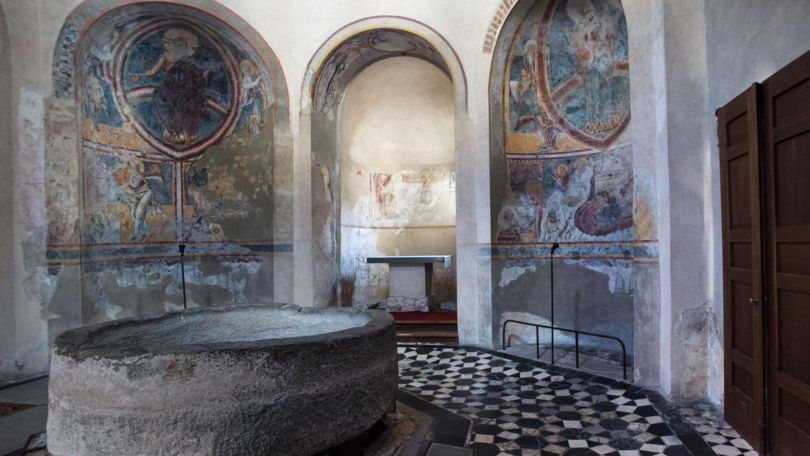
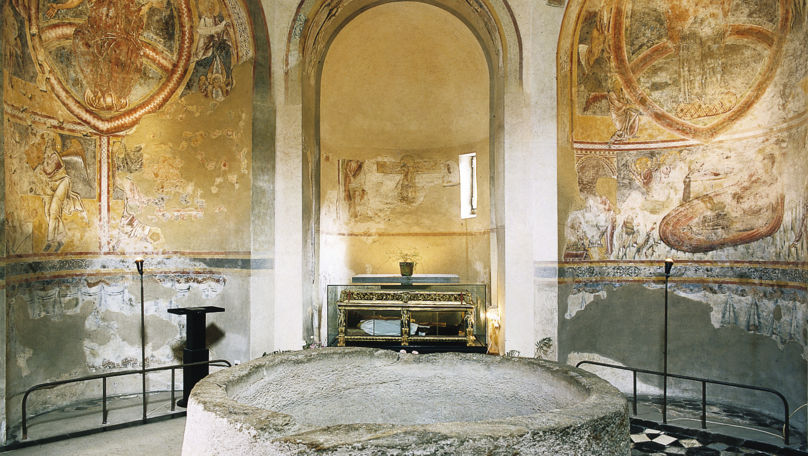
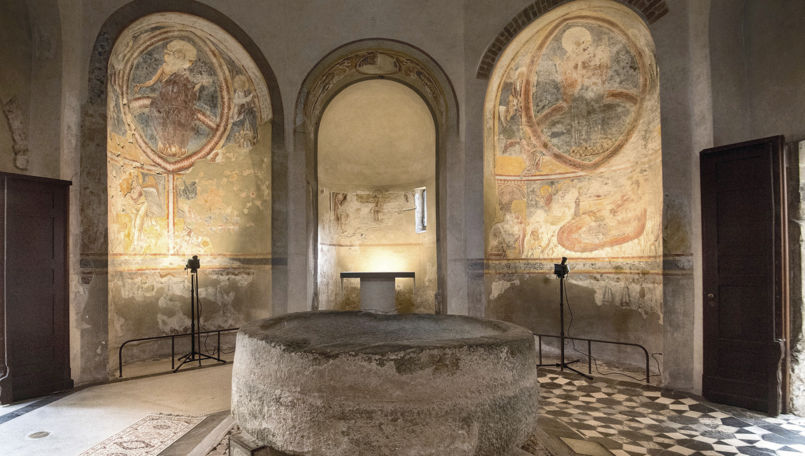
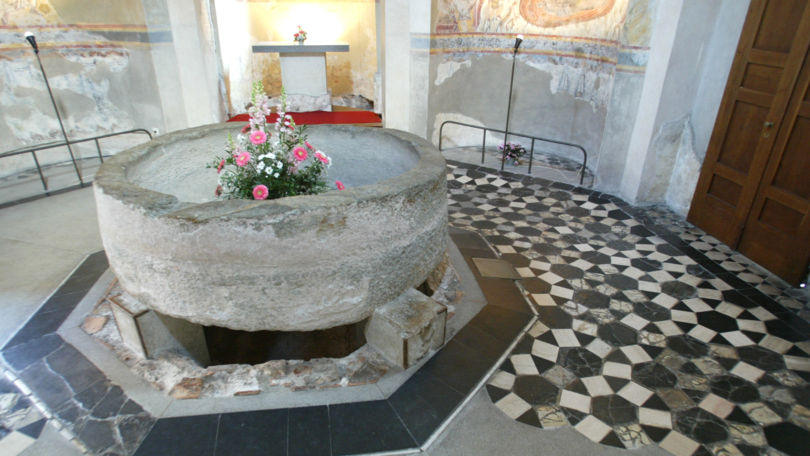
Inside, the octagonal immersion font is fitted with steps and a drain, still visible beneath the monolithic tub that was placed over it in the 9th century. The practice of immersion baptism was abolished during the 9th and 10th centuries. The baptismal font in Arzo, set in the recess to the left of the northern entrance, is the last one known to have been used for the rite.
Within the semicircular recesses carved from the thickness of the walls and along the columns, layered traces of 12th-century Romanesque frescoes survive, the most recent dating to the 17th century. Underfoot, much of the original flooring remains intact -- a striking mosaic of black and white marble tiles arranged in geometric inlays, a quiet masterpiece in its own right.