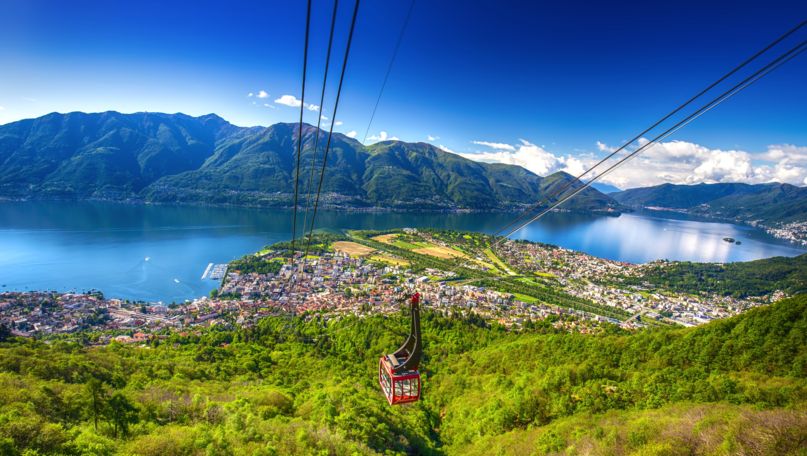
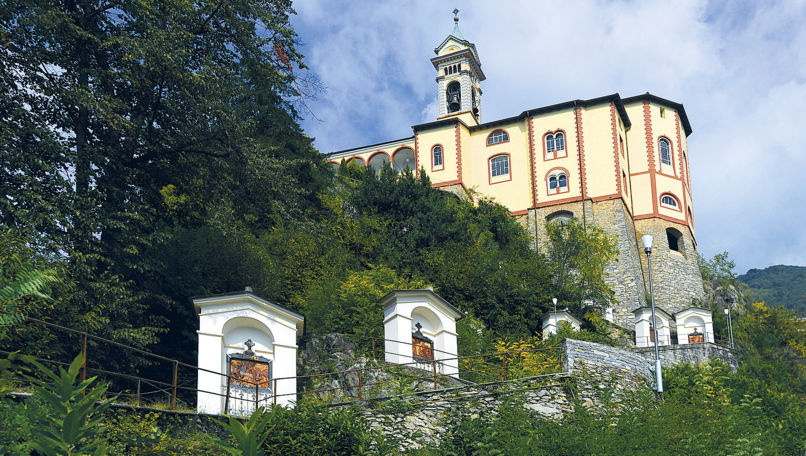
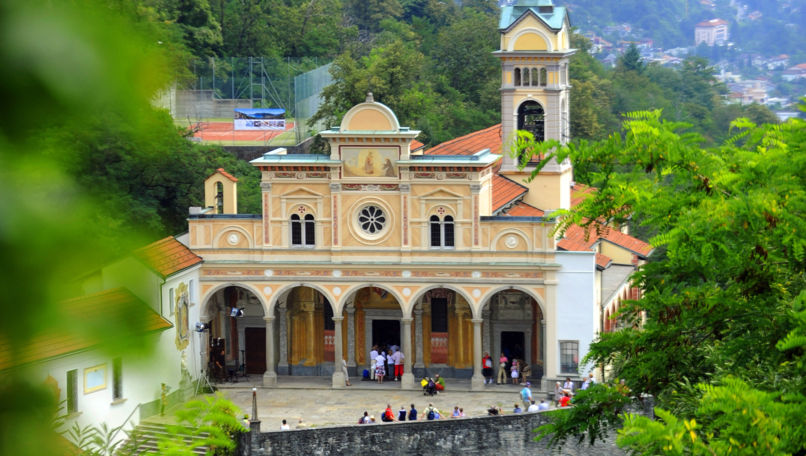
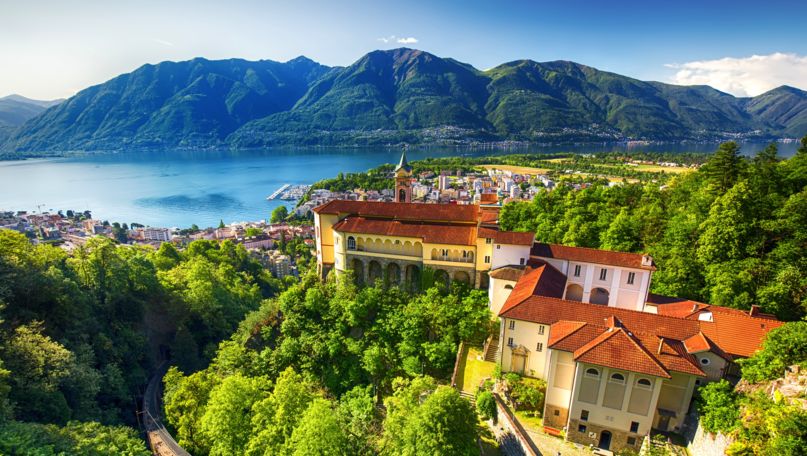
High above Locarno, where a rocky promontory juts skyward and the whole of the lake region shimmers below, the Madonna del Sasso (Our Lady of the Rock) in Orselina commands one of the most breathtaking settings of any sanctuary in Switzerland. It is the most important pilgrimage site in the Italian-speaking part of the country, a place where faith, art, and landscape merge into a single, deeply moving experience. For centuries, pilgrims have ascended the Sacred Mountain where, according to tradition, the Virgin Mary appeared in 1480. Two routes lead upward: the steep Via Crucis or the gentler trails through a natural valley dotted with chapels. Those who prefer comfort can ride the funicular railway from Locarno. Numerous works of art -- stuccoes, frescoes, ex-votos, canvases by Bramantino and Ciseri -- were revitalised by a comprehensive restoration completed in 2013.
The visit
The 2013 restoration returned the basilica to a luminous splendour. Whether you are returning to the Sacro Monte or discovering it for the first time, you will find a site of exceptional value for its location, its history, and its artistic and spiritual riches. The architectural complex encompasses the basilica and the Franciscan convent, set at the tip of a sharp-cornered rock, as well as the church of the Annunciation, the Via Crucis, and several chapels.
Tradition recounts that in 1480, Brother Bartolomeo of Ivrea experienced a vision of the Virgin Mary with the Infant on this very hill. The devotion of the local population led to the construction of a first chapel. Over the following centuries, the idea of the Sacro Monte took shape -- a form of religious architecture common to the lake region, in which churches and chapels are arranged along a devotional route and woven into a captivating, secluded natural landscape.
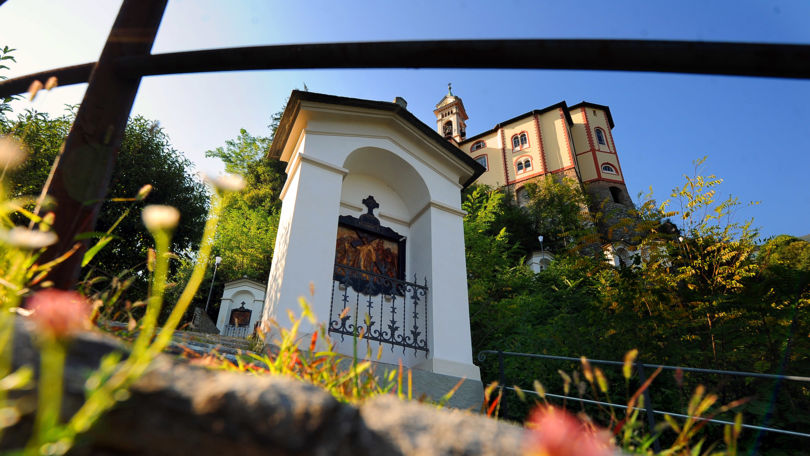
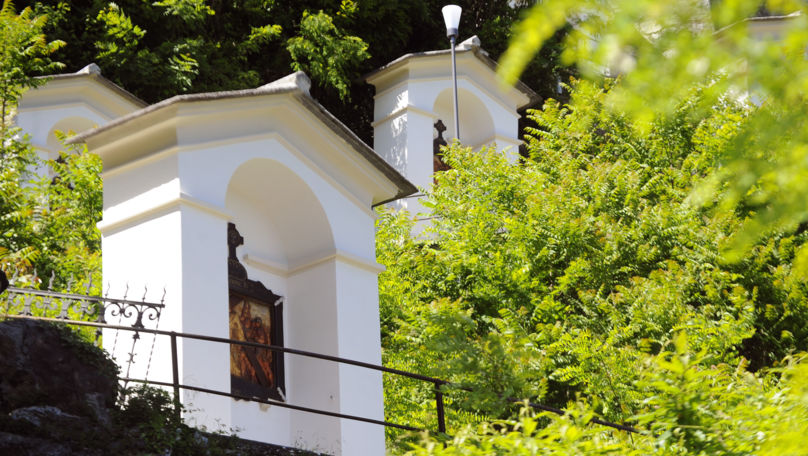
The sanctuary, a place of meditation and pilgrimage for centuries, is accessible by funicular from Locarno to Orselina (Santuario stop) or on foot in approximately 30 minutes. Leave the Locarno porticos and climb via Via delle Monache and Via del Sasso to the 16th-century church of the Annunciation. A short distance further, the path forks: to the left, the Via Crucis ascends past twelve chapels illustrating scenes of the Passion; to the right, a trail winds through the quiet valley.
The basilica stands on a vast terrace where the gaze sweeps across the inner Locarno region. Inside, treasures abound: the statue of the Madonna del Sasso, a precious wooden sculpture from the late 1400s, and countless ex-votos testifying to the centuries of devotion inspired by the apparition -- painted canvases, oils, embroidery, silver hearts. Two masterpieces crown the collection: the altarpiece "Flight into Egypt" by Bramantino (circa 1520) and the deeply affecting "Transport of Christ to the Sepulcher," painted by Antonio Ciseri of Ronco above Ascona in Florence around 1870.
The stucco and fresco decorations inside the church have reacquired their luminosity following the restoration. Be sure not to miss the chapel in the courtyard, which contains the altarpiece of the "Lamentation" from the end of the 15th century.
The Madonna del Sasso Museum
Located in the oldest wing of the convent, the museum reopened at the end of September 2016. It occupies the original spaces where four friars once lived, including the refectory adorned with a magnificent fresco of the Last Supper.
Eight exhibition rooms explore the conventual life of the Capuchin friars and the history of the convent as an integral part of the Pre-Alpine Sacred Mountains. Of particular note is the largest collection of ex-votos in Ticino, mostly dating from the 19th and 20th centuries, including works by Valmaggese artist Giovanni Antonio Vanoni (1810-1886). Two rooms are dedicated to preparatory works and several replicas of "The Transport of Christ to the Sepulcher." The original by Ticino artist Antonio Ciseri (1821-1891), considered one of the greatest 19th-century painters of religious subjects, hangs in the church above.